Does Fermentation Make Food Safer? What to Know About Fresh Fermented Foods and Food Safety
When foodborne illness makes headlines, it’s a reminder that how our food is grown, handled, and prepared matters.
Recently, concerns around Cyclospora have many people asking an important question:
Does fermentation make food safer?
The short answer is that fermentation plays an important role in food preservation—but it’s only one part of food safety.
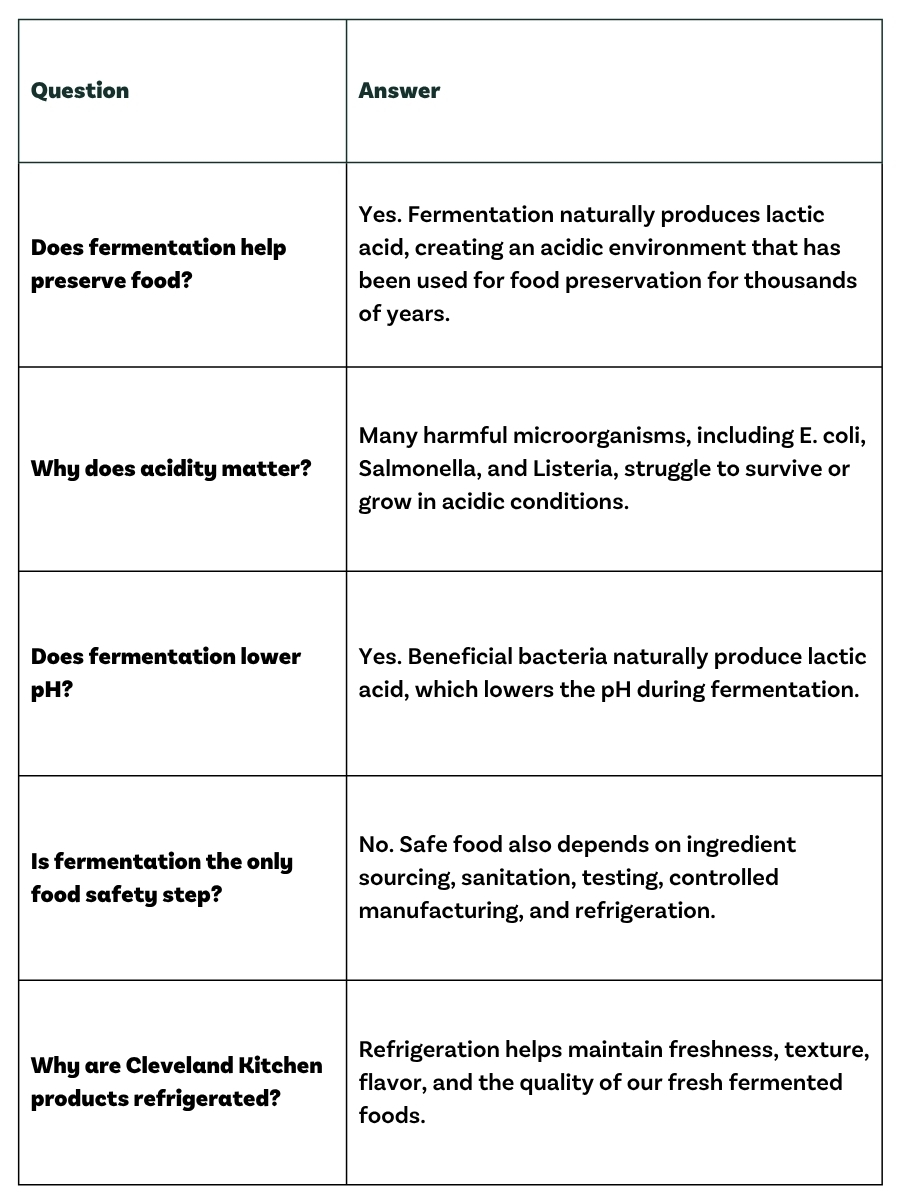
During fermentation, beneficial bacteria naturally produce lactic acid, creating an acidic environment where many harmful microorganisms, including E. coli, Salmonella, and Listeria, struggle to survive or grow. Combined with careful sourcing, rigorous food safety practices, quality testing, and refrigeration, fermentation has been trusted for thousands of years as an effective way to help preserve food.
At Cleveland Kitchen, food safety isn’t the result of one process. It’s built into every step—from the vegetables we source to the way every batch is fermented, tested, and refrigerated before it reaches your table.
Does Fermentation Support Food Safety?
Yes. Fermentation supports food safety by naturally lowering a food’s pH through the production of lactic acid.
During lactic acid fermentation, naturally occurring beneficial bacteria—known as lactic acid bacteria (LAB)—consume the natural sugars found in vegetables. As they do, they produce lactic acid, causing the food to become more acidic over time.
This increasingly acidic environment makes it difficult for many harmful microorganisms, including E. coli, Salmonella, and Listeria, to survive or grow, which is one of the reasons fermentation has been used as a food preservation method for thousands of years.
Today, modern food manufacturers pair this time-tested process with rigorous food safety systems, environmental monitoring, laboratory testing, and refrigeration to help ensure every product meets strict quality standards.
Why Does Acidity Matter?
Every food has a pH, which measures how acidic or alkaline it is.
As vegetables ferment, beneficial bacteria naturally produce lactic acid, lowering the pH of the food.
That drop in pH is significant because many harmful microorganisms, including E. coli, Salmonella, and Listeria, struggle to survive or grow in acidic environments. This natural acidification is one of the reasons fermentation has long been recognized as an effective method of food preservation.
At Cleveland Kitchen, we carefully monitor our fermentation process to ensure it consistently reaches the conditions needed to produce a safe, high-quality product.
The result is food that’s not only full of bold flavor and satisfying crunch, but produced through a carefully controlled fermentation process.
What Is Fresh Fermentation?
Not all fermented foods are made the same way.
Fresh fermentation is the natural process of fermenting vegetables with beneficial bacteria while keeping the product refrigerated rather than heat processing it after fermentation.
Unlike many shelf-stable products, Cleveland Kitchen’s fresh fermented vegetables remain refrigerated throughout distribution and storage.
This helps preserve:
- Crisp texture
- Bright, fresh flavor
- Naturally occurring live cultures
- The quality of fresh fermented vegetables
It’s a different approach that reflects our belief that fresh simply tastes better.
Food Safety Starts Long Before Fermentation
Fermentation is an important part of our process, but it’s only one piece of a much larger food safety system.
Safe food begins long before fermentation.
At Cleveland Kitchen, we work with trusted suppliers that follow rigorous food safety programs and best agricultural practices designed to help prevent contamination before vegetables ever reach our facility.
From there, every batch is supported by:
- Carefully sourced, high-quality vegetables
- Rigorous food safety standards
- Controlled fermentation
- Continuous quality testing
- Refrigerated storage and distribution
Food safety isn’t the result of one process—it’s the result of multiple safeguards working together.
Fermentation & Food Safety at a Glance
The Bottom Line
Food safety is never about one single process.
It’s the result of thoughtful sourcing, careful manufacturing, scientific testing, proper refrigeration, and proven preservation methods working together.
Fermentation has earned its place in that process because it naturally creates an acidic environment where beneficial bacteria thrive while many harmful microorganisms struggle to survive or grow.
At Cleveland Kitchen, we’re proud to combine this centuries-old tradition with modern food safety practices to create fresh fermented foods that are flavorful, crunchy, and made with care.
Whether you’re enjoying sauerkraut, kimchi, or another fresh fermented favorite, you can feel confident knowing every bite reflects a process built on prevention, quality, and science.
Frequently Asked Questions About Fermentation and Food Safety
Does fermentation support food safety?
Yes. During fermentation, beneficial bacteria naturally produce lactic acid, lowering a food’s pH. This acidic environment makes it difficult for many harmful microorganisms, including E. coli, Salmonella, and Listeria, to survive or grow. Fermentation is one part of a broader food safety system that also includes careful sourcing, sanitation, quality testing, and refrigeration.
Why are fermented foods acidic?
During fermentation, naturally occurring lactic acid bacteria consume the natural sugars found in vegetables and produce lactic acid. This lowers the food’s pH, giving fermented foods their characteristic tangy flavor while also helping preserve the food.
Why do fresh fermented foods need to stay refrigerated?
Fresh fermented foods like Cleveland Kitchen krauts and kimchi are not heat processed after fermentation. Refrigeration helps maintain their crisp texture, fresh flavor, and naturally occurring live cultures while preserving product quality throughout their shelf life.
Are all fermented foods refrigerated?
No. Some fermented foods are heat processed after fermentation to make them shelf stable. Fresh fermented foods remain refrigerated from production through purchase, helping preserve their fresh taste, texture, and live cultures.
Continue reading



Find Us Online
& In-Store
Big flavor. Real benefits. Find us nationwide—always fresh, always in the fridge.



%201.avif)


%201.avif)