Live Cultures vs. Probiotics: What’s the Difference?
If you’ve ever wondered whether “live cultures” and “probiotics” mean the same thing, you’re not alone.
They’re often mentioned in the same breath on packaging, in articles, and in conversations about gut health. But while they’re related, they’re not identical.
Luckily, understanding the difference doesn’t require a science degree. It just requires a little clarity about what each term actually means and what it doesn’t.
Quick Answer: Live Cultures vs. Probiotics
Live cultures are living microorganisms naturally present in fermented foods. Probiotics are specific strains of live microorganisms that have been scientifically studied for a defined health benefit at a particular dose.
In simple terms:
- All probiotics are live cultures
- Not all live cultures are probiotics
Both can play a role in supporting gut health, but they aren’t interchangeable terms.
.jpg)
What Are Live Cultures?
Live cultures are living microorganisms that are present in a food when you eat it.
They typically develop naturally during fermentation. As vegetables, dairy, or other ingredients ferment, beneficial bacteria grow and multiply as part of the process. If the food isn’t heat-treated afterward, many of those microbes can remain alive at the time of consumption.
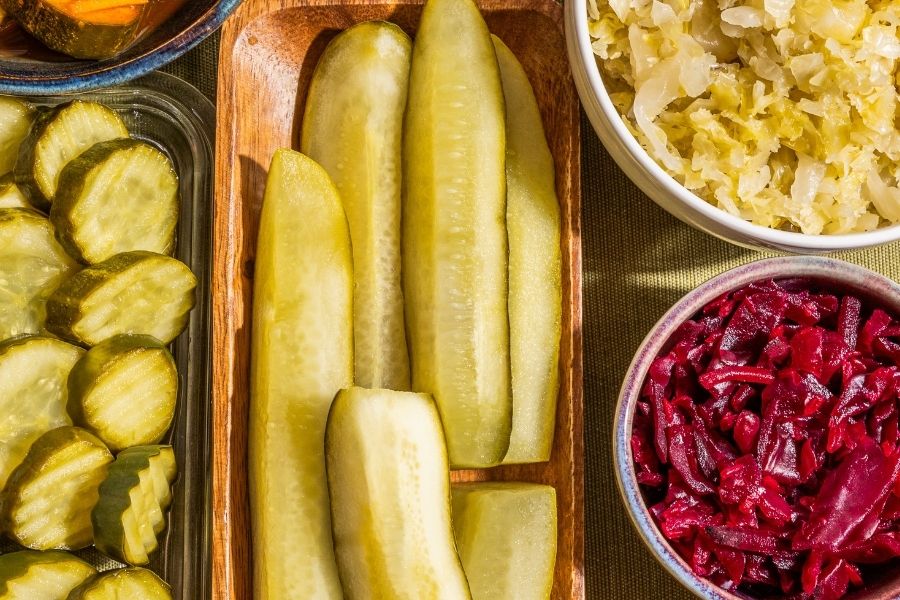
You’ll most often find live cultures in traditionally fermented foods that are kept refrigerated and minimally processed—think sauerkraut, kimchi, yogurt, kefir, and kombucha.
Cold storage helps preserve what fermentation creates, including living microbes and the natural compounds formed during the process.
At Cleveland Kitchen, our fresh fermented and lightly fermented products are kept refrigerated to help maintain the integrity of the live cultures developed during fermentation. That fresh fermentation approach is central to our mission of creating foods that are both flavorful and functional.
Importantly, “live cultures” simply describes what’s present in the product. It doesn’t automatically mean those microbes meet the formal definition of probiotics.
What Are Probiotics?
Probiotics are a more specific category.
The International Scientific Association for Probiotics and Prebiotics (ISAPP) defines probiotics as:
“Live microorganisms that, when administered in adequate amounts, confer a health benefit on the host.”
Two key ideas are built into that definition:
- The microorganism must be clearly identified down to the specific strain
- That strain must have research demonstrating a defined health benefit at a particular dose
In other words, probiotics aren’t just any live bacteria. They are particular strains that have been studied and tested in clinical settings.
This is why probiotic supplements typically list:
- full strain names
- colony-forming unit (CFU) counts
- targeted outcomes associated with those strains
Examples include:
- Lactobacillus plantarum
- Lactobacillus rhamnosus GG
- Bifidobacterium lactis
Some fermented foods may also naturally contain strains that have been studied.
For example, Cleveland Kitchen’s fresh fermented and lightly fermented products contain Lactobacillus plantarum, a strain that has been widely researched for its role in supporting gut health. At the time of packing, our products are tested to contain between 10 million and 100 million CFUs per serving.
That means our products deliver both naturally occurring live cultures developed during fermentation and a researched probiotic strain—combining traditional fermentation with strain-specific validation.
Are Live Cultures the Same as Probiotics?
Not exactly.
Live cultures describe living microbes present in a food.
Probiotics describe specific strains that have been scientifically studied and validated for a particular benefit at a defined level.
Some fermented foods contain live cultures without containing clinically studied probiotic strains. Others may contain both.
Understanding that distinction makes the rest of the conversation around gut health much clearer.
Why Refrigeration Matters for Live Cultures
Not all fermented foods contain live cultures by the time you eat them.
Heat treatment, shelf-stable processing, and extended storage can reduce or eliminate living microbes even if a food was originally fermented. That’s why some products labeled “fermented” don’t necessarily contain live cultures.
Refrigerated, minimally processed fermented foods are more likely to retain living microbes because cold storage helps preserve microbial viability without killing it.
If live cultures are important to you, storage instructions matter just as much as ingredient lists.
Fermented Foods vs. Probiotic Supplements
Fermented foods and probiotic supplements aren’t competitors. They simply serve different roles.
Fermented Foods
Fermented foods are whole foods meant to be eaten regularly as part of everyday meals. They may contain:
- diverse communities of live microbes
- fiber
- nutrients
- organic acids
- fermentation-derived compounds
They also bring flavor, texture, and culinary versatility to meals.
Probiotic Supplements
Probiotic supplements are formulated around specific strains delivered in standardized doses. They’re often used with targeted, strain-specific goals in mind.
One is a food-first approach integrated into daily eating. The other is a more precise intervention designed around specific strains. Both can fit into a broader wellness routine, they simply operate differently.
Why Fermented Foods Continue to Gain Attention
Researchers continue studying the relationship between fermented foods, the gut microbiome, and overall wellness.
One frequently discussed Stanford study found that diets rich in fermented foods were associated with increased microbiome diversity and reduced inflammatory markers in participants.
While gut health is influenced by many factors—including sleep, stress, movement, fiber intake, and overall diet—fermented foods continue to attract attention as a flavorful, food-first way to support gut health.
The Bottom Line
All probiotics are live cultures, but not all live cultures are probiotics.
Live cultures tell you living microbes are present. Probiotics refer to specific strains that have been studied and validated at defined levels.
Fermented foods offer a whole-food way to include live cultures in your daily routine, while probiotic supplements deliver targeted, strain-specific precision.
Some products provide one or the other. Cleveland Kitchen’s fresh fermented and lightly fermented products are designed to deliver both naturally occurring live cultures developed through fermentation, along with a researched probiotic strain tested at meaningful levels at the time of packing.
Understanding the difference helps you make more informed choices—and better understand how fermentation, refrigeration, and probiotic science can work together in the same product.
Frequently Asked Questions
Are live cultures probiotics?
Not always. Probiotics are specific strains of live microorganisms that have been scientifically studied for a health benefit. Live cultures is a broader term.
Do all fermented foods contain live cultures?
No. Some fermented foods are pasteurized or heat-treated after fermentation, which can reduce or eliminate living microbes.
Does sauerkraut contain probiotics?
Fresh refrigerated sauerkraut may contain live cultures and probiotic strains, depending on how it is produced and processed.
Why are refrigerated fermented foods important?
Refrigerated fermented foods are more likely to retain live cultures because they are typically not heat-treated after fermentation.
What’s the difference between probiotic supplements and fermented foods?
Probiotic supplements deliver specific researched strains in controlled amounts, while fermented foods provide a whole-food source of live cultures alongside fiber, nutrients, and fermentation-derived compounds.
Continue reading




Find Us Online
& In-Store
Big flavor. Real benefits. Find us nationwide—always fresh, always in the fridge.



%201.avif)


%201.avif)